Looking for your council? This page is for councils choosing live chat software, and the chat button on this page is IMsupporting's own sales chat, which can't help with council tax, bins, housing or other council services.
Live Chat for Councils That Works When the Phone Lines Are Full
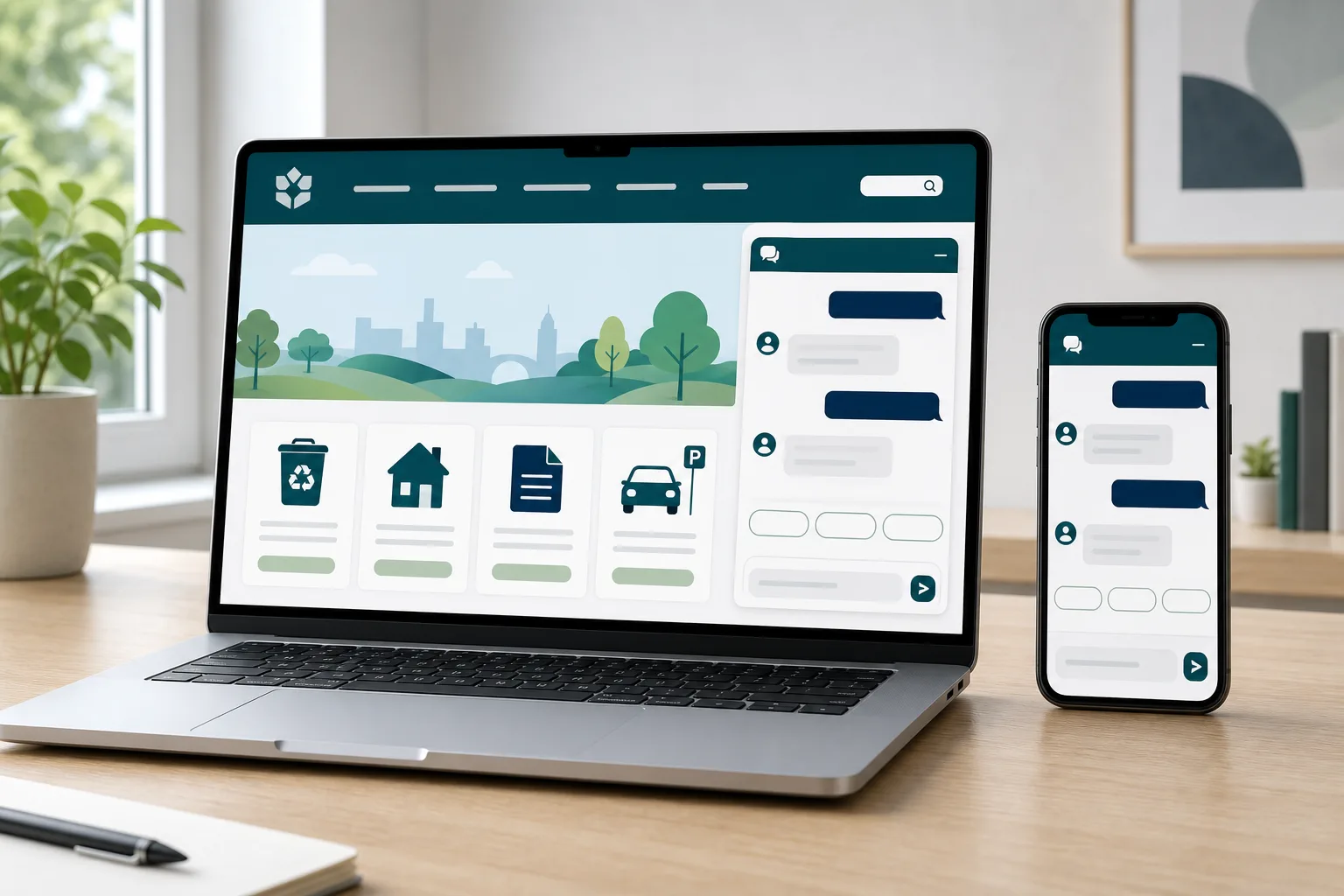
Add live chat and an AI chatbot to your council website without losing the human touch. AI answers routine questions about bins, council tax and services from your own guidance. Sensitive journeys go straight to officers, with the whole conversation in front of them, and chat opens automatically when your team is online.
Already in use with police forces and councils across the UK.
Council digital contact
What is council live chat, and how is it different from a council chatbot?
Council live chat, also called council webchat or local authority live chat, is a text conversation on a council's website between a resident and the council. It can be answered by customer service officers, by an AI chatbot (sometimes called a council AI assistant) working from the council's own guidance, or by both. A local government chatbot on its own answers automatically; staffed live chat connects residents to people; hybrid live chat does both, with AI handling routine questions and officers taking anything that needs judgement.
Councils are adding it because demand keeps rising while budgets don't. The Local Government Association expects a £7.0 billion funding gap by 2028-29, and the government agreed in principle to give exceptional financial support to 36 councils in England for 2026-27. Satisfaction with councils, and trust in them, are at their lowest since national polling began in 2012. Every enquiry that chat answers, or routes correctly first time, frees an officer for the residents who most need one.
Council demand and finances in numbers
£7.0bnfunding gap facing councils in England by 2028-29LGA, July 2026
36councils in England given in-principle exceptional financial support for 2026-27, a number the LGA calls unprecedentedMHCLG, 2026
27,625complaints to the Local Government and Social Care Ombudsman in 2025-26, up 33%LGSCO, 2026
135,580households in temporary accommodation in England, a recordMHCLG, 31 March 2026
51%of people are satisfied with how their council runs things, the lowest since polling began in 2012LGA polling, published January 2026
6%of UK adults have no internet at home, so phone and face-to-face routes still matterOfcom, 2026
MHCLG's Local AI team names customer service and casework administration among its priority areas and plans to build and test AI-assisted customer support with councils. In July 2026, after hearing from 60 councils, it announced funding for the LGA to co-deliver resources, including an AI playbook for local government. That playbook aims to help councils align with national standards such as the AI Playbook for the UK Government.
Residents are getting used to grounded AI answers. GOV.UK Chat officially launched in the GOV.UK app on 14 May 2026: it only uses GOV.UK guidance to answer questions and links the pages it uses, and the government has said helplines will remain available. Council chat should follow the same principles: a clear AI label, answers based on your own content and a person when it matters. Unlike GOV.UK Chat, IMsupporting's AI doesn't show residents the pages it used and can fall back on general knowledge, so test it against your content before go-live.
Councils are moving carefully. In the LGA's latest State of the Sector report on AI (2025), 95% of responding councils were using or exploring AI, but half were only at the beginning. Most (68%) saw organisational reputation and resident trust as a great or moderate risk, and only 41% were using a specific AI policy to manage AI risks.
What residents say about AI in public services
Trust has to be earned. Only 40% of the UK public trust the public sector to use AI responsibly, and 52% think the public should be consulted before it's introduced (Nesta, December 2025). In the government's 2025-26 Public Engagement Survey, 74% of adults were concerned that information produced by AI might be inaccurate. In a separate survey by the Ada Lovelace Institute and Alan Turing Institute, 55% said more human involvement would make them more comfortable with AI, up from 44% in a Great Britain sample in 2022-23.
That's why IMsupporting's council live chat software is built for hybrid contact: AI for routine questions, trained officers for anything that matters, a clear route between the two, and the phone and front desk still there for residents who need them.
Published results from councils using other suppliers
Councils publish their results in committee papers and transparency records. These councils use other suppliers; we quote their published figures to show the pressure on phone lines and what chat can do, not as IMsupporting results.
Buckinghamshire Council: its chatbot handled 44,437 enquiries in January to March 2026 and passed 4,086 (about 9%) to a member of staff, while the average phone wait was 5 minutes 37 seconds against a 3-minute target.Buckinghamshire Council performance report, January to March 2026
Oxfordshire County Council: in the first month of a chatbot pilot for its temporary congestion charge, 1,819 people asked it 3,772 questions, and only 5% escalated to a member of staff. A natural language voice bot on its switchboard cut calls by about 55% in its first weeks.Oxfordshire County Council customer experience report, 2026
Barnet Council: its algorithmic transparency record for a chatbot pilot says that, on average, 90% of the queries the chatbot has content for end up being answered correctly, that it is designed to connect residents to the contact centre when chat is staffed, and that a DPIA was completed in May 2024.GOV.UK algorithmic transparency record, January 2025
Newport City Council: it publishes its contact centre figures. In July to September 2026, callers hung up on 11,546 of 39,424 calls (29%) before they were answered, including 28 of 46 calls to its Welsh-language line.Newport City Council contact centre data, 2026
A review of 101 council AI case studies for the Local Policy Innovation Partnership Hub (April 2026) found more case studies in customer service than in any other council function. It also found "a lack of robust quantitative evidence" on the impact of AI in local government. Measure your own results from day one: see live chat KPIs for councils.
High-volume resident enquiries
Use chat where residents already get stuck
Chat works best on the services that generate the most repeat contact. These are the journeys councils build first, each one a branch of the chat flow your own team designs. Some suit AI and self-service; others must go straight to trained people.
Where AI and self-service help most
High-volume, rules-based questions with published answers, which AI or a lookup can handle at any hour.
Waste, Recycling and Simpler Recycling
From 31 March 2026 every council in England that collects household waste must collect the same core recycling from all households, including flats, with free weekly food waste collections, though councils with a transitional arrangement have a later start date for food waste. Defra announced in July 2026 that plastic film collections will be put back to 1 April 2030. One in four councils (79) told the BBC they would miss the food waste deadline, so caddy deliveries and new rounds continue. Chat explains what goes in which bin, checks collection days through your waste system's API with no AI involved, and sends missed collection reports straight to the waste team.
Sources: Defra; BBC News, February 2026; letsrecycle, July 2026
Council Tax and Business Rates
Average Band D council tax in England rose 4.9% to £2,392 for 2026-27, arrears reached £7.4 billion, and business rates moved to five new multipliers after the 1 April 2026 revaluation. Chat explains bands, discounts and how to pay, routes account questions to revenues officers, and gives anyone in arrears or hardship a direct route to a person.
Source: MHCLG council tax and collection statistics, 2026
Benefits and Cost of Living Support
In Great Britain, working-age Housing Benefit ended for most claimants on 30 June 2026, and in England the Crisis and Resilience Fund replaced the Household Support Fund from April 2026, bringing Discretionary Housing Payments into the same grant. Its guidance says councils must offer at least two ways to apply for crisis and housing payments, such as online, by phone or face to face, so digitally excluded people aren't shut out. Chat explains who can apply and how, and passes urgent need to people quickly.
Sources: DWP; Crisis and Resilience Fund guidance, 2026
Planning, Building Control and Licensing
District-level planning authorities in England received 78,700 planning applications in April to June 2026 alone. Chat explains validation requirements, fees, timescales and how to comment on an application from your published guidance, so planning officers spend less time repeating it. Licensing questions, from taxi licences to events, work the same way.
Source: MHCLG planning statistics, 2026
Highways, Parking and Report It
Councils in England dealt with 1.26 million fly-tipping incidents in 2024-25. Chat captures what, where and when as structured text and sends it to the right team by email or straight into your system's API. Residents can't attach photos in the chat, so link to your report forms when you need them. For parking permits and penalty charge notices, explain the rules and link to your payment and challenge pages.
Source: Defra fly-tipping statistics, 2026
Registrars, Blue Badges and Everyday Services
In England and Wales a birth must be registered within 42 days, and a death within 5 days of confirmation that it can be registered, so registration appointments are time critical. The Microsoft 365 Calendar step books them inside the chat, and can add a Teams link to any appointment you hold by video. In March 2025, 3.07 million Blue Badges were held in England. Chat also answers Blue Badge eligibility and renewal questions, library and leisure enquiries, and the questions that spike around elections and school admissions deadlines.
Sources: GOV.UK; Department for Transport, 2026
Where people must stay in charge
Risk, vulnerability, statutory duties and complaints. Chat can answer general process questions, collect details and route quickly, but a trained officer handles anything involving risk, a concern or a decision.
Housing Repairs, Damp and Mould
In England, Awaab's Law has applied to council landlords since 27 October 2025: emergency hazards must be made safe within 24 hours, and significant damp and mould investigated within 10 working days. From 30 November 2026 Phase 2 adds hazards such as excess cold, falls and electrical hazards. Chat can capture a structured hazard report, send emergencies straight to people and keep a timestamped record of when you were told. It supports your process; it doesn't make you compliant.
Source: MHCLG Awaab's Law guidance, 2025 and 2026
Homelessness and Housing Options
A record 135,580 households, including 177,530 children, were in temporary accommodation in England on 31 March 2026. Under the Housing Act 1996, someone in England is threatened with homelessness if it is likely they will become homeless within 56 days, so these chats go straight to your housing options team, with your out-of-hours emergency number in the journey.
Sources: MHCLG; Housing Act 1996, section 175
Adult Social Care Front Door
In England, the Care Act 2014 requires councils with adult social care responsibilities to run an accessible information and advice service. Of the 2.02 million requests for support from new clients in 2024-25, 71% ended with no further action, a category that mainly covers cases where the council provided no services, gave information and advice, or signposted people to other services. Chat can carry that advice from your published guidance. Safeguarding concerns are different: councils received an estimated 640,240 in 2024-25, and they belong with trained staff, never an AI.
Sources: Care Act 2014, section 4; DHSC statistics, 2025
Children's Services, SEND and Safeguarding
There were 718,838 education, health and care plans in England in January 2026, up 12.5%, and only 46.1% of new plans were issued within the 20-week limit. Chat can answer process questions and route parents to the right team. Any concern about a child's safety goes to your children's services front door, with 999 for emergencies.
Source: Department for Education, 2026
Domestic Abuse
An estimated 3.8 million people aged 16 and over in England and Wales experienced domestic abuse in the year to March 2025. Route these journeys straight to trained officers with no AI in the conversation. The widget has no quick-exit button, so host them on pages with your own exit control, such as the GOV.UK Design System's Exit this page component, and don't ask for an email address on these journeys, because a copy of the chat can be emailed to any address the journey captures.
Sources: ONS, 2025; GOV.UK Design System
Complaints
Complaints to the Local Government and Social Care Ombudsman about councils in England rose 33% in 2025-26, and it upheld 86% of those it investigated. Since April 2026 it has applied its Complaint Handling Code in its casework: the Code is advice and guidance for councils in England, and says residents should be able to complain in any way and to any member of staff. A complaint made in chat is a complaint: give it a clear journey, a contact category (you can make categories compulsory before any chat closes) and a transcript copy for your complaints team.
Source: LGSCO, 2026
All Human / Hybrid / Full AI
Councils need flexibility, not an AI-only chatbot
A resident asking about bin day is very different from a resident worried about eviction, debt, domestic abuse or homelessness. IMsupporting makes AI a controlled front door, not a replacement for trained people, and your council decides how much AI to use and where.
All Human
All Human: Every chat goes to an officer
Switch AI off for the whole account (the Human Only setting): the AI agent, reply suggestions, chat summaries and Deep Learning (which turns chats your officers have handled into knowledge for future AI answers) all stay off, and every chat goes to a person. Ideal for sensitive services, or until your DPIA and AI policy are signed off.
Hybrid, our recommendation
Hybrid, our recommendation: AI first, people when it matters
AI answers routine questions from your guidance and collects details, and when a chat passes to an officer the whole conversation is on screen. Officers can take over any AI chat at any moment, and the AI hands over whenever a resident asks for a person while officers are online.
Full AI, when you're closed
Full AI, when you're closed: Routine help outside office hours
When nobody is online, the AI agent can keep answering routine questions and your flow can take a message for the next working day. Nobody is watching at these times and the AI doesn't assess risk, so keep risk journeys off this route, say when messages will be read and show emergency numbers.
Guardrails that matter in local government
Answers are grounded in the documents your council uploads and the background description of your council that you write in the AI settings. Where those don't cover a question the AI can draw on general knowledge, so test it before going live.
The AI agent doesn't assess risk or recognise vulnerability, so ask about safety before any AI step and keep risk journeys with people.
It hands over when a resident asks for a person and officers are online, and is made to hand over if someone repeats the same message three times or it has replied 15 times. Officers can take over any AI chat at any time.
AI intent and sentiment branches (beta) act only when the model's own confidence score meets a fixed threshold; otherwise they take your fallback route. They are routing aids, not safety controls.
Lookups that involve personal account data, such as a council tax balance, can run through API Form or API Conditional steps that involve no AI at all.
Built-in defences against prompt-injection attempts in resident messages, and instructions that tell the AI to stay on your council's topics and decline anything else.
Label the AI clearly, as the AI Playbook for the UK Government advises. For example, name the assistant "Virtual assistant (AI)" and say in its first message that it's AI and how to reach a person.
IMsupporting's own log of AI requests is redacted after 24 hours, unless placed on legal hold.
Assistant: Hello, I'm the council's virtual assistant (AI). I can help with bins, council tax and other services, or connect you to an officer. What do you need?
Assistant: Sorry about that. What's your postcode and house number? I'll check your collection.
An API Form step checks your waste system, with no AI involved, and shows the round status and next collection date. Still not sorted? One tap passes the chat to the waste team with the details on screen.
Chose "Repair in my council home"? The flow asks about danger first, and emergencies such as flooding or exposed wiring go straight to the repairs team.
Illustration of a typical journey. Your council writes every message and decides every route.
Select to enlarge. Upload your guidance in the Agent Knowledge Base.
An AI that knows your council's services
Residents don't want generic answers; they want to know about their own council's services. Upload your service guidance, policies and FAQs as PDF, Word, Excel, CSV or text files, up to 5MB each, and the AI answers using them: garden waste subscriptions, how to apply for a parking permit, what happens after a planning application is submitted. It doesn't crawl your website, so you choose exactly what it uses.
Administrators can test the knowledge base and see which documents an answer came from. New documents are used once they're indexed, so try them in a pilot first. Officers also get AI reply suggestions drawn from the same knowledge, which they can use, edit or ignore. Prefer no generative AI at all? The FAQ Module gives residents searchable, council-written answers.
Council chatbot, webchat or hybrid AI live chat?
How the three approaches compare for council customer services
What matters
AI chatbot on its own
Human-only webchat
IMsupporting hybrid AI live chat
Routine questions out of hours
Answered
Closed, or forms only
Answered by the AI agent or your FAQ Module, with an offline form for anything else
Vulnerable residents
Relies on the bot spotting it
A trained officer
Sensitive journeys go straight to people. The AI doesn't assess risk; it hands over when asked, and officers can take over any AI chat
Annual billing, elections, bad weather
Scales
Queues grow, or chat is switched off
Queue Gate offers alternatives when the queue is long, and AI keeps answering routine questions
Context when an officer takes over
Varies
Not applicable
Full conversation and flow answers, with an AI summary one click away
Opening hours
Always on
Set hours or a manual switch
Automatic, from who is online, plus office hours and bank holidays
Welsh language
Often relies on machine translation
Depends on staffing
Journeys your team writes in Welsh, and a Cymraeg department that opens when a Welsh-speaking officer is online
Who makes decisions
Mostly the bot
People
The AI answers routine questions; officers handle anything you route to them and can take over any AI chat
Want the wider picture? Read how hybrid AI live chat works across Full AI, Hybrid and All Human modes.
See it working for a council journey. Book a demo and we'll walk through a waste or council tax flow, the officer view and the reports.
Designing live chat that is safe for vulnerable residents
Council contact includes people in crisis. IMsupporting's AI answers questions but doesn't assess risk, so safety comes from how your journeys are designed. Build these five rules in from the start.
Ask about safety first. On housing repair, social care, children's and domestic abuse journeys, ask whether anyone is in danger before anything else. 999 becomes a tap-to-call link; add your out-of-hours emergency numbers to the message, where they show as text.
Send risk to people, not AI. Homelessness, safeguarding, domestic abuse, arrears and hardship journeys go to Human Chat steps in the right department. Departments route and label chats but don't limit who can see them, so everyone who signs in should be trained to handle these conversations. Keep the AI agent to information journeys.
Plan for when nobody is online. The flow checks whether chat is open, and that check covers your whole team, not one department, so whenever chat is open make sure someone trained for these journeys is online. If chat is closed, show emergency contacts and an offline form that says when it will be read, and never send a risk journey to AI cover.
Protect privacy on sensitive pages. Use your own quick exit, don't ask for an email address on those journeys (a captured address can be sent a copy of the chat), and remember AI suggestions, summaries and Deep Learning are account-wide: switch them off, or use Human Only, if no sensitive text should reach the AI provider.
Keep a clear record. Compulsory categories and private notes stay in IMsupporting, and the chat.closed webhook can send the category, the resident's answers and the transcript to your case management or records system; private notes are never included.
Example: "I'm worried about losing my home"
Council: If you or anyone else is in danger right now, call 999. Do you have somewhere safe to stay tonight?
Yes
No (chosen)
"No": the flow checks whether chat is open. If it is, the chat goes to the Housing options department and the resident sees their place in the queue. If not, it shows your out-of-hours emergency homelessness number and takes a message.
"Yes": the flow asks whether they could lose their home in the next eight weeks, then, if chat is open, passes the chat to the Housing options department with the answers on screen. No AI agent takes part.
Illustration of a journey design. Your council writes every message, sets every route and decides where AI is allowed.
No-code ChatFlow Builder
Chat workflows built for council services
Every journey is a branch of the chat flow your team designs in the ChatFlow Builder (one live flow per account): drag and drop, with version history, a live preview and no developers. More than 30 step types cover safety questions, routing, structured questions, lookups in your own systems, handover and feedback.
Select to enlarge. A general-purpose hybrid flow from our demo account. Council flows add service choices and safety questions, as in the example.
Example: reporting damp and mould in a council home
Message: "If anyone is in danger, call 999." Add your out-of-hours emergency repairs number; 999 becomes a tap-to-call link.
Button Group Branch: "Is this an emergency, such as flooding, exposed wiring or a home that isn't safe tonight?" Yes goes straight to people; No carries on.
Custom Form Fields: which rooms are affected, how long it has been happening and whether anyone in the home has a health condition.
API Conditional: asks for the address, checks your housing system for an open repair job there and branches on the answer.
Conditional, Operators Are Online: yes goes to Human Chat in the Housing repairs department, showing the resident's queue position; no goes to an Offline Form that says when messages are read.
Feedback: a 1 to 5 rating and an optional comment.
When the chat closes: a signed chat.closed webhook sends the details and transcript to your housing system, with the time you were told.
The steps council flows use most
Talk
Message
Button Group Branch
Collect Info
Custom Form Field
Pre-Chat Fields
FAQ Module
Feedback
Route
Conditional
Department Select
Set Department
Time of Day
Holiday / Date Override
Queue Gate
Page Match
Language Router
AI
AI Agent Chat
AI Intent Branch beta
AI Sentiment Branch beta
AI Extract Info beta
People
Human Chat
Offline Form
Connect
Webhook
API Form
API Conditional
Email Form
Microsoft 365 Calendar
When it's busy, or you're closed
Queue Gate branches when the queue reaches a level you set, so you can offer the AI agent, FAQs, an online form or a call-back booking instead of a long wait, and residents who do wait see their place in the queue. Time of Day and Holiday / Date Override steps handle evenings, weekends, bank holidays and the Christmas closure. For seasonal peaks such as annual council tax bills in March, garden waste renewals and elections, update your guidance and add a journey for the peak.
Route by service, team and page
Send residents to departments with Department Select, and start the right journey for the page they're on with Page Match, so the council tax page starts a council tax journey. AI Intent Branch (beta) classifies free text and falls back to the route you choose when it isn't sure.
Automatic chat availability: live chat that opens when your officers are online
Residents search for their council's live chat opening times, and some council chat pages list only short windows when chat is staffed. A chat button that promises help nobody is there to give frustrates residents and creates repeat contact. Automatic mode makes availability predictable: chat opens as soon as someone who can answer is Online, falls back cleanly when nobody is, and reopens without anyone having to remember.
Chat stays open while at least one person is Online in Team status. Busy, AFK (away from keyboard), On break and Getting ready don't count.
Each department opens and closes on its own, based on who covers it: planning can close while council tax and waste stay open.
Office hours for the whole account, with up to three opening periods a day, up to 60 closed days such as bank holidays, and clock changes handled for you.
Outside office hours, chat with officers is closed whoever is signed in; residents see your offline message or offline form, or the AI agent if you use it to cover closed hours.
A "Getting ready" sign-in status lets officers sign in and settle before they take chats.
Every automatic open and close is written to the audit log with the reason.
Prefer to switch chat on and off yourself? Manual mode keeps the familiar switch, with one switch per department when queues are turned on in your settings.
Office hours 08:30-17:00 weekdays. Closed days: bank holidays and 25 December to 1 January.
Illustration of Chat Availability in Automatic mode. Names, teams and hours are examples.
Built for council contact centres
Useful from day one, configurable for every department
Chat should make officers faster, not busier. The tools customer service officers and team leaders use every day are in one browser-based console, at the office, in a hub or at home.
Several chats at once
Handle several chats in tabs, up to a limit you set for the account. Sound, on-screen and desktop alerts flag new chats as they arrive.
Transcripts and private notes
Every chat keeps a transcript, and an AI summary is one click away when AI is on. Private notes stay internal: they never appear in the resident's copy or in webhooks.
Department routing
Route chats to council tax, waste, housing or any team from the flow or the page they start on, and move a chat to another department in one click. Each department can send transcript copies to its own mailbox.
Canned replies and categories
Approved wording on a keystroke, and a contact category you can make compulsory before a chat closes, so reporting matches how you classify demand.
Follow-ups and signed-in residents
After a call or visit, an administrator can send one resident a single-use prepared chat link with their details already filled in. A signed-in council portal can pass context, such as an account reference, so officers don't ask twice; it comes from the browser, so treat it as unverified.
Nuisance and abusive contacts
Officers can tag repeat or nuisance visitors, and administrators can ban by IP address or device, with an optional expiry. Banned visitors see a generic message, so keep emergency numbers on your page.
Team leaders and wallboards
A supervisor view gives administrators live chats at a glance, and a wallboard shows waiting chats, people online, response times and abandoned chats, refreshing every five seconds.
AI help for officers
With AI on, officers get suggested replies from the conversation and your knowledge base, which they can edit before sending, and a one-click chat summary when they take over. Switch them off for the whole account if you prefer.
Handed over from AIMissed bin
Answers from the chat flow
Collection
Recycling
Address
12 Example Road
Missed on
Yesterday
Context from your website
Started on
Bins and recycling page
Department
Waste and recycling
Officer tools
AI summary
Private note
Canned replies
Change department
The full AI conversation sits above these details in the same chat.
Illustration of what an officer sees at handover. Details are examples.
Webhooks, APIs and Microsoft 365
Webhooks and integrations with council systems
Chat shouldn't be another silo. IMsupporting sends signed events to your systems as things happen, and chat flows can look things up in your systems mid-conversation.
Four webhook events, signed and retried
Webhook events and typical council uses
Event
Sent when
Typical council use
chat.started
A resident starts a chat, with an officer or the AI agent
Live dashboards, or an alert in a Microsoft Teams channel through Power Automate
chat.closed
A chat ends: visitor details, pre-chat answers, chat details, the AI summary when the summary email on close is switched on, and the transcript (newest 500 messages) if you opt in
Create or update a case in your CRM, file the transcript in your records system, or log a missed collection or repair report
offline_message.created
A resident leaves a message while chat is closed
Create a task for the next working day
feedback.submitted
A rating or comment is left
Feed resident satisfaction reporting, for example in Power BI
Open Standard Webhooks format, signed with HMAC-SHA256, so your developers can verify every message with an off-the-shelf library.
Usually sent within a minute. Failed deliveries are retried for about a day, the delivery log keeps 30 days of history, and you can re-send recent events from it for 3 days.
Webhook events go to HTTPS endpoints only, and never include visitor IP addresses or private notes.
Adding an endpoint, turning on transcripts or creating a new secret needs an administrator, asks for their two-factor code when they use two-factor sign-in, and emails the account owner.
One endpoint and 500 events a day on free and trial accounts, and up to five endpoints and 20,000 events a day on paid plans.
Example chat.closed event, shortened. Values are illustrative.
Lookups in your own systems, without AI
API Form and API Conditional steps send a resident's answers to your endpoint, server-side, and show the reply or branch on it: a bin collection day by postcode, a repair job status, a permit application. No AI is involved, so personal account data stays out of the AI provider. They post to your endpoint, so a GET-only API needs a small wrapper.
AI tools for general information
Custom AI tools let the AI agent call your approved HTTPS APIs, server-side, and explain the answer conversationally, such as service status or opening times. The API's reply goes to the AI provider to write the answer, so use API steps for personal data. See AI tool integrations.
Microsoft 365 and Teams
The Microsoft 365 Calendar step books slots and Teams meetings from inside a chat, for registration, housing options or call-back appointments. Your Microsoft 365 administrator registers an app with Calendars.ReadWrite and User.Read.All permissions; we recommend limiting it to the booking mailbox. See Teams meeting booking.
CRM, case management and line-of-business systems
There are no built-in connectors to council CRM, case management, revenues, housing or waste systems. Events and API calls go to endpoints your council controls, such as Power Automate, Azure Logic Apps or your integration platform, which then update your systems under your own rules.
Help to connect
The AI Integration Helper in your dashboard answers questions about connecting IMsupporting to tools such as Microsoft Teams, Zapier, Make and n8n, and our team offers free integration assistance. Check any third-party tool against your DPIA.
Email forms and transcripts
An Email Form step sends structured answers, such as a missed bin or graffiti report, to a team mailbox. Transcripts can go to your team, with copies for each department, and residents who give an email address can be sent a copy of their own conversation, which never includes private notes.
Assurance
AI governance, security and data protection your council can explain
Here's the summary for your DPO, information governance, IT security and procurement colleagues; our assurance pack covers the detail.
Where data is stored and processed
Chat data is stored in UK data centres. On standard plans, when AI features are on, chat text is processed by our AI provider, OpenAI, outside the UK, and documents you upload to the AI knowledge base are indexed through OpenAI too; OpenAI doesn't use API data to train its models. Emails are sent through Amazon SES in Ireland. About UK hosting and data location.
UK-only AI processing on Enterprise
On Enterprise, the AI, including knowledge base indexing, runs in the UK, for example on Microsoft Azure OpenAI in UK South: chat text stays in the UK, isn't used to train models and isn't stored by the AI provider. An enhanced contract can run the models on our own dedicated clusters in UK South, with no third-party AI provider. .
Cyber Essentials certified
IMsupporting holds Cyber Essentials certification, the standard the National Procurement Policy Statement points to for managing supply chain risk, and we'll provide our security documentation and questionnaire responses during procurement.
Two-factor sign-in
Authenticator-app codes with recovery codes, which administrators can require for every officer account. It matters: the ICO fined one software supplier £3.07 million after attackers got in through a customer account without multi-factor authentication. Single sign-on with Microsoft Entra ID or another SAML provider, and sign-in limited to your network, can be set up for Enterprise and bespoke deployments. About two-factor sign-in.
Roles and support access
Officers handle chats; administrators manage settings, chat flows, integrations and users. IMsupporting staff can only open your account for support after re-entering a fresh two-factor code, and each access is logged.
Encryption
Chat messages, private notes, archived transcripts and queued webhook payloads are encrypted with AES-256-GCM and a separate key for each account, and connections use TLS. This extra layer doesn't yet cover visitor details, pre-chat answers, chat flow answers or offline messages, which are held in the UK database.
Audit logs
Administrators can search the last 90 days of account activity, including sign-ins and chat availability changes. On Enterprise, audit records are kept for as long as your council requires.
Supporting your DPIA
Your council is the controller and IMsupporting the processor, under a data processing agreement that meets UK GDPR Article 28; we'll provide it with our sub-processor list. The ICO says most uses of AI need a DPIA. The widget also records page visits and a device identifier on pages where it loads, for visitor monitoring and chat continuity, so include it in your cookie and PECR assessment.
Retention and records
On Enterprise, every retention period is configurable: chats, transcripts, visitor details and audit records are kept for as long as your retention schedule requires, and no longer. On other plans, retention and deletion are agreed in your data processing agreement. You can also send each transcript to your records system with the chat.closed webhook. Transcripts can be council records, so include chat in your FOI and subject access processes.
How the platform supports the AI Playbook for the UK Government
The AI Playbook for the UK Government (February 2025) sets 10 principles for using AI safely and responsibly. It's written for government departments and other public sector organisations, so councils can use it, although it doesn't bind them, and MHCLG is funding the LGA to co-deliver a planned local government AI playbook that aims to help councils align with it. The UK Government Playbook also says that for chatbots, where people can't review every answer in real time, it's important to keep human control at other stages. It adds that automated responses to the public should be clearly identified. Responsibility stays with your council; these are the controls IMsupporting gives you.
AI Playbook principles and IMsupporting controls
Principle
How IMsupporting supports it
1. You know what AI is and what its limitations are
We say plainly what the AI does and doesn't do: it answers from your documents, can fall back on general knowledge, doesn't assess risk and can make mistakes. Administrators can test answers before go-live.
2. You use AI lawfully, ethically and responsibly
A data processing agreement, help with your DPIA and equality impact assessment, chat data stored in UK data centres, and Human Only mode where AI isn't approved.
3. You know how to use AI securely
Prompt-injection defences, two-factor sign-in, encryption at rest for messages and notes, rate limits on the public chat, and our AI request log redacted after 24 hours.
4. You have meaningful human control at the right stages
You decide which journeys use AI; sensitive journeys go straight to officers, who can take over any AI chat. The AI makes no decisions about residents.
5. You understand how to manage the full AI life cycle
You choose and update the documents the AI uses, test changes, review transcripts and feedback, and can switch AI off for the whole account at any time.
6. You use the right tool for the job
The FAQ Module and API Form lookups answer common questions with no AI at all; AI handles routine questions; people handle everything else.
7. You are open and collaborative
Name the assistant, say in its first message that it's AI, and publish an algorithmic transparency record; we'll provide the technical details it needs.
8. You work with commercial colleagues from the start
Published prices, a 30-day free trial, an assurance pack for procurement, and answers to the optional AI disclosure questions in PPN 017.
9. You have the skills and expertise needed to implement and use AI solutions
A no-code ChatFlow Builder, a workflow user guide, help with your first flows and free integration assistance.
10. You use these principles alongside your organisation's policies and have the right assurance in place
Settings that follow your AI policy (AI per journey, Human Only, account-wide AI assist switches), 90 days of searchable audit logs (kept longer on Enterprise), UK-only AI processing on Enterprise, and our Cyber Essentials certificate in the assurance pack.
Publishing an algorithmic transparency record
The Algorithmic Transparency Recording Standard (ATRS) has been mandatory for central government departments since 6 February 2024 and is recommended for the wider public sector. Its scope policy gives a website chatbot that answers the public as an example of a tool in scope. Councils including Barnet and Leeds have published ATRS records for chatbots from other suppliers. Barnet's record for its chatbot pilot is a useful example: it explains what the chatbot does, how it connects residents to a person when chat is staffed, and when the DPIA was completed.
If your council publishes a record, we'll give you the technical details it asks for: what the AI does, the data it uses, the providers involved and how officers stay in control.
The Data (Use and Access) Act 2025
New UK GDPR rules on automated decision-making (Articles 22A to 22D) came into force on 5 February 2026. For significant decisions made solely by automated means, people must be told and be able to make representations, get human intervention and contest the decision. IMsupporting's AI answers questions and collects details; it doesn't make decisions about residents, so keep decisions with your officers.
Since 19 June 2026 every controller must facilitate data protection complaints, for example with a complaint form that can be completed electronically and by other means, acknowledge each complaint within 30 days and, without undue delay, respond and tell the complainant the outcome. A "data protection complaint" journey that routes straight to your information governance team is one simple way to offer that route in chat.
Need the detail for your DPO or procurement panel? Ask for our assurance pack: Cyber Essentials certificate, data processing agreement, sub-processor list and security questionnaire responses.
Inclusive by design
Accessibility, Welsh language and channel choice
Every council, including town and parish councils, is covered by the Public Sector Bodies (Websites and Mobile Applications) (No. 2) Accessibility Regulations 2018. GOV.UK says a site meets the legal requirements if it meets WCAG 2.2 AA and publishes an accessibility statement, with limited exceptions such as a properly assessed disproportionate burden. Third-party content is exempt only if you neither paid for nor developed it and don't control it, so a chat widget your council buys is your responsibility, and any known issues belong in your accessibility statement.
It matters: when GDS monitored public sector websites from 2022 to 2024, only 29% of local government websites in its simplified tests were acceptable at the 12-week retest, the lowest of the five public sector areas it reported.
Accessibility features inside the chat window
Inside the chat window, new messages are announced to screen readers, the message box and send button are labelled, controls meet the WCAG 2.2 minimum target size, reduced-motion settings are respected and the chat goes full screen on phones. For the most accessible start, open chat from your own labelled link or button, and include the chat in your accessibility testing.
Consistent help
WCAG 2.2 added success criterion 3.2.6, Consistent Help: where a help mechanism is repeated on multiple pages within a set of web pages, it must appear in the same order relative to the rest of the page content, unless the user changes it. W3C's guidance gives chat as an example, so keep your chat link in the same position across your site.
Your colours, your contrast
Set bubble, button and text colours, font sizes, logo and avatars to match your accessible palette, and decide where the chat button sits.
Deaf and disabled residents
One in four people in the UK (16.7 million) is disabled, and RNID estimates more than 18 million adults are deaf, have hearing loss or tinnitus. In RNID's 2024 survey, 64% of BSL users said they had faced negative attitudes from call centre staff in the previous 12 months. Chat gives these residents a direct, written route; keep Relay UK and your BSL services alongside it.
Plain English
18% of adults in England aged 16 to 65 have low literacy. Every message, button and pre-chat question is yours to write, so keep them short and plain, as GOV.UK's writing guidance advises, with clear "not for emergencies" wording.
Keep every door open
6% of UK adults have no internet at home, and 82% of them say nothing would prompt them to go online. The Local Government and Social Care Ombudsman's good-practice steps for councils include keeping other ways to make contact when services move online. Chat adds a channel; it should never replace the phone or front desk.
Welsh Language Standards and live chat
The Welsh Language Standards (No. 1) Regulations 2015 apply to Wales's county and county borough councils, and each council's compliance notice sets out which standards apply to it. Standard 52 requires Welsh text on every page, fully functional Welsh pages and Welsh not treated less favourably than English (some notices apply standards 53 and 54, covering the homepage and new or amended pages, instead); standard 56 requires the interface and menus on every page in Welsh; and apps must work fully in Welsh (standard 57). In August 2025 the Welsh Language Commissioner's statement on AI said chatbots that provide services in English only, without equivalent Welsh provision, contravene the standards. It also encouraged organisations to make sure any AI system is specifically tested in Welsh before it is deployed.
In IMsupporting your team can write Welsh versions of every journey, offer a Cymraeg / English choice as the first button, route Welsh-language pages with Page Match and open a Cymraeg department automatically when a Welsh-speaking officer is online. There are limits: the widget's built-in labels and status messages are in English only, and texts such as the header and offline message hold one version for every resident, so write them bilingually and check the widget against your compliance notice. There's no automatic translation, so test the AI in Welsh before you use it, as the Commissioner advises, or keep Welsh journeys with Welsh-speaking officers.
Scotland and Northern Ireland
Each of Scotland's 32 councils is a listed authority under the British Sign Language (Scotland) Act 2015 and must publish its own BSL plan. Since 30 November 2025 the law has stated expressly that Gaelic has official status in Scotland, and councils prepare Gaelic language plans where Bòrd na Gàidhlig requires one.
Northern Ireland's councils have the section 75 duty to have due regard to the need to promote equality of opportunity across nine groups, including people with and without a disability. Wherever you are, build your chat journeys, accessibility testing and equality impact assessment around the duties that apply to your council.
Every tier, every nation
For every council: county, district, unitary, metropolitan, London, town and parish
England has 317 principal councils, Scotland 32, Wales 22 and Northern Ireland 11, plus around 9,000 to 10,000 town and parish councils in England. Council live chat works the same way for all of them; the journeys change with the services each one runs.
21county councils
164district councils
62unitary authorities
36metropolitan districts
32London boroughs
2City of London and the Isles of Scilly
Local government reorganisation: one chat across merging councils
The English Devolution White Paper (December 2024) set out plans to replace two-tier areas with unitary councils. In Surrey, a structural changes order signed in March 2026 replaces the county council and 11 district and borough councils with two new councils, East Surrey and West Surrey, from 1 April 2027. Decisions for other areas were withdrawn or paused for review in September 2026, so timetables elsewhere are uncertain.
Reorganisation changes resident contact: several websites, merging contact centres and residents asking which council to contact. One IMsupporting account can run across all the predecessor websites, with Page Match starting the right journey for each site and departments for each service. Until vesting day each council is a separate data controller and every officer can see every chat, so put a data sharing or joint controller arrangement in place first and make sure the data processing agreement covers every council, or run separate accounts until vesting day. There's one knowledge base per account, so write answers that say which area they apply to. Signed webhooks can follow your systems as they change.
Strategic authorities and mayors
The English Devolution and Community Empowerment Act received Royal Assent on 29 April 2026, and the government's July 2026 Rewiring the State statement aims for strategic authorities across England by the end of 2028. Chat suits their public enquiries too, from transport and skills to business support.
Wales, Scotland and Northern Ireland
Welsh councils work under the Welsh Language Standards, Scottish councils buy under Scottish procurement law, and Northern Ireland's 11 councils run a narrower set of services, such as waste and recycling and leisure centres. Your journeys, knowledge and procurement route follow your nation's rules.
Town and parish councils
A town or parish council may be run by a single clerk with limited office hours, yet the accessibility regulations still apply to its website. The free plan gives one officer account (one chat at a time), an AI agent with 25 AI credits a month and limited document uploads; an AI-answered chat uses about one credit. Solo (£49.99 a month plus VAT) gives up to three officers and 500 AI credits a month. The clerk answers chats when available; the rest of the time the AI agent answers from your uploaded documents, or the FAQ Module from FAQs you write: meetings and minutes, allotments, hall hire, burial grounds and grants. An offline form takes messages for the next working day.
Council websites and CMS
Add live chat to any council website or CMS
IMsupporting runs in the browser, so there's nothing to install on officers' PCs, and it works on any website or CMS that lets your team add a script, whether that's LocalGov Drupal, Jadu, GOSS, Granicus, WordPress or something else.
Ways to add chat to your site
A chat button on every page, added with one script tag generated in your dashboard, or only on high-demand service pages. WordPress sites can use our plugin.
Or your own labelled "Chat with us" link or button, using your Direct Chat Link to open chat in its own window. It's the most accessible way to start a chat.
Start the right journey for each page with Page Match, or preset a department per page.
Print a QR code made from your Direct Chat Link on letters and posters; anyone can reuse it. For a follow-up to one named resident, a prepared chat link carries their details.
Pass details from a signed-in council portal, such as name, email or an account reference, so residents aren't asked twice. They come from the resident's browser, so treat them as unverified.
See which pages residents are on and invite them to chat where they get stuck, such as a council tax reduction or housing application page.
Content Security Policy and privacy
If your site uses a Content Security Policy, it needs to allow *.imsupporting.com; our installation guide lists the domains to allow. The widget records page visits and a device identifier on pages where it loads, so cover it in your privacy notice and cookie assessment.
Evidence, not anecdotes
Measuring success: live chat KPIs for councils
Independent evidence on AI in councils is still thin, and most published results come from suppliers. Build your own evidence from day one, starting with a one-question pre-chat dropdown: "Would you otherwise have phoned us?"
Demand by hour and day of the week: staff the channel to match.
Time to first response and chat length: live on the wallboard and in reports.
Abandoned chats and journey drop-off: the journeys residents start, complete or leave, step by step.
Contact categories: reporting that matches how your council classifies demand, including progress chasing.
Resident satisfaction: ratings, comments and your own questions, with an optional AI summary of themes, which works even in Human Only mode and sends the feedback to the AI provider only when an administrator runs it.
Channel shift: the "Would you otherwise have phoned us?" answers, alongside call volumes for the services you move into chat.
Select to enlarge. Hourly demand and journey completion, from our demo account. Select to enlarge. Feedback report measures, from our demo account.
Avoidable contact and old benchmarks
Councils once reported avoidable contact as National Indicator 14, which was scrapped in 2010. The idea still matters. The government's State of Digital Government Review (January 2025) says failure demand is particularly relevant to local government. It reports that Defra estimates 60% of its contact centre calls come from broken or unclear digital journeys. Treat old benchmarks with care, too. Channel costs you may still see quoted, such as £8.62 face to face, £2.83 by phone and 15p online, come from Socitm benchmarking in 2012. Staffed chat isn't free either: ContactBabel's 2026 UK guide puts the average inbound call at £6.17, 83% more than a web chat, so a staffed chat still costs more than half as much as a call. Measure your own.
Implementing live chat or an AI chatbot at your council? Start small: one service, run alongside the phones, with success measures agreed up front.
Discover
Agree the journeys, opening hours and success measures, and complete your DPIA and equality impact assessment with our support.
Build
Your team builds flows, uploads approved guidance and sets up departments and availability, with our help on the first flows.
Pilot
Go live on one service, such as waste or council tax, in All Human or Hybrid mode, with any AI clearly labelled.
Review and scale
Use the reports and resident feedback to decide what comes next: more services, more teams, AI cover out of hours.
Procurement and assurance
The Procurement Act 2023 has applied to councils in England, Wales and Northern Ireland since 24 February 2025; Scottish councils buy under Scottish procurement law, including the Procurement Reform (Scotland) Act 2014. From 1 January 2026 the threshold for sub-central goods and services contracts is £207,720 including VAT. In England and Wales, a council that advertises a contract worth £30,000 or more including VAT must first publish a below-threshold notice on the Central Digital Platform (Find a Tender), or through Sell2Wales in Wales. You can also buy through our partner framework vendors; contact us for details. We'll support your route and provide the assurance pack.
Upgrading from another webchat
Run IMsupporting alongside your current chat on one service or team first, rebuild your journeys and canned replies, then switch over when you're ready. It runs in the browser, so there's nothing to install on officers' PCs.
Pricing
A pilot usually runs on the Business plan (£1,499 a month plus VAT, up to 20 officers and 10,000 AI credits a month), so 12 months costs £17,988 plus VAT. Council-wide deployments run on Enterprise, with bespoke pricing, dedicated UK hosting, UK-only AI processing, retention set to your schedule and an SLA. If your information governance team needs UK-only AI processing or set retention from day one, and we can upgrade your pilot to Enterprise terms while you test, or run the pilot in Human Only mode. Town and parish councils can start free or on Solo (£49.99 a month plus VAT). Solo and Business both start with a 30-day free trial. See all plans.
Council live chat FAQ
Questions local authorities ask first
I need to contact my council. Is this the right place?
No. This page is for councils choosing live chat software, and the chat on this page is IMsupporting's own sales chat, which can't help with council tax, bins, housing or any other council service. Find your local council on GOV.UK and use the contact details on its website. If someone is in immediate danger, call 999.
What is the difference between a council chatbot and live chat?
A council chatbot answers residents automatically, usually from the council's own content. Live chat, or webchat, connects residents to customer service officers in real time. Hybrid live chat combines the two: AI answers routine questions and collects details, and officers take anything that needs judgement, with the whole conversation in front of them. IMsupporting does all three in one widget, and AI is optional.
Can the AI answer from our own council website and documents?
From the documents you upload, yes; from your live website, no, because it doesn't crawl websites. Upload PDF, Word, Excel, CSV or text files up to 5MB each, such as service pages saved as PDFs, policies and FAQs, so you choose exactly what it uses. Where your documents don't cover a question it can draw on general knowledge, so test it before go-live: administrators can test answers and see which documents they came from. If you'd rather not use generative AI, the FAQ Module gives residents council-written answers with no AI at all.
Can sensitive enquiries bypass AI?
Yes. Any journey can go straight to an officer with no AI agent in the conversation: homelessness, domestic abuse, safeguarding, arrears and hardship, for example. AI reply suggestions, chat summaries and Deep Learning (which learns from chats your officers have handled) are account-wide settings, so switch them off, or run the whole account in Human Only mode, if no text from sensitive journeys should reach the AI provider.
Does the AI recognise vulnerability or risk in what residents type?
No. The AI agent doesn't assess risk or recognise distress by itself. It hands over when a resident asks for a person, or after the same message three times or 15 AI replies, and only when officers are online. So design for it: ask about safety first, send journeys involving risk or vulnerability straight to people, keep the AI to information journeys, and keep an eye on live AI chats.
How does a chat pass from the AI to an officer, and what does the officer see?
Your chat flow decides first: a choice such as 'repair in my council home' can go straight to the housing team. The AI agent hands over when a resident asks for a person and officers are online, and officers can take over any AI chat at any time. The officer sees the whole AI conversation, the answers the resident gave in the flow and any context passed from your website, and can produce an AI summary in one click when AI is on. Residents don't have to repeat themselves.
Does live chat replace council customer service staff?
No. It takes routine, repeat questions off the phone lines and gives officers better context for the conversations that need human judgement. Keep phone and face-to-face routes too: 6% of UK adults have no internet access at home, and the Local Government and Social Care Ombudsman's good-practice steps for councils include keeping other ways to make contact when services move online.
Can live chat open only when officers are online, and what happens out of hours?
Yes. In Automatic mode, chat (and each department) opens while at least one person who covers it is Online in Team status, and closes about a minute after the last one leaves. Office hours, with up to three opening periods a day and up to 60 closed days such as bank holidays, are set once for the whole account. Out of hours, residents see your offline message, an offline form that says when messages will be read, or the AI agent answering routine questions. Keep emergency numbers in view at those times.
Can each department have its own queue and opening hours?
Partly. Create departments such as council tax, waste, housing repairs or planning, route chats to them from the flow or the page they start on, and open or close each one separately, automatically from who covers it or by hand. Office hours and closed days are set once for the whole account, so if one service keeps shorter hours, add a Time of Day step to its journey. There's one shared queue, departments label chats rather than hide them, every officer can see every chat, and there's one knowledge base per account.
Can residents check their bin day or report a missed collection in the chat?
Yes, if your waste system has an API that can be reached over the internet (internal network addresses are blocked). An API Form step sends the resident's postcode or address to your system and shows the answer, such as the next collection date, with no AI involved. It posts to your endpoint, so a lookup that only accepts GET requests needs a small wrapper. Missed collection reports can go to the waste team's mailbox with an Email Form step, or into your system through an API step.
Can residents upload photos of fly-tipping, potholes or damp and mould?
No. Residents can't attach photos or files in the chat. Chat can capture what, where and when as structured text and pass it to the right team, so link to your online report forms when you need photos.
Can residents pay for council services in the chat?
No. Chat doesn't take payments. It can explain charges and link residents to your own payment pages, and your Pre-Chat Page can remind residents not to share bank card details in the chat.
Can we connect chat to our CRM or case management system?
Yes, through your own integration layer. Signed webhooks send chat started, chat closed (with the transcript if you opt in), offline message and feedback events to your HTTPS endpoints, and chat flow steps can post captured details to your APIs. There are no built-in connectors to council CRM, case management or line-of-business systems: your team, or ours, links the events to them, for example with Power Automate or your integration platform.
Will it work on our council website or CMS?
It works on any website or CMS that lets your team add a script, such as LocalGov Drupal, Jadu, GOSS, Granicus or WordPress, which also has a plugin. If your site uses a Content Security Policy, it needs to allow *.imsupporting.com. You can also open chat from your own labelled link or button using your Direct Chat Link, which is the most accessible way to start a chat.
Where is chat data stored, and which AI providers are used?
Chat data is stored in UK data centres. On our standard plans, when AI features are switched on, chat text is processed by our AI provider, OpenAI, outside the UK, and documents you upload to the AI knowledge base are indexed through OpenAI too; OpenAI doesn't use API data to train its models. On Enterprise, AI processing can run in the UK instead (see the next question). Emails are sent through Amazon SES in Ireland. In Human Only mode the AI agent, suggestions, summaries and Deep Learning are off, and the optional AI analysis buttons in Reports only send data if an administrator uses them. We'll give you the full sub-processor list for your DPIA.
Can AI processing stay in the UK?
Yes, on Enterprise. We can run the AI, including knowledge base indexing, in the UK, for example on Microsoft Azure OpenAI in the UK South region, so resident chat text stays in the UK, isn't used to train models and isn't stored by the AI provider. For the most sensitive services, an enhanced Enterprise contract can run the AI models on our own dedicated clusters in UK South, so no third-party AI provider handles chat text at all. Both options are priced by our sales team, and a pilot can be upgraded to them while you test: .
Will it support our DPIA, equality impact assessment and ATRS record?
Yes. We provide a data processing agreement, our sub-processor list and the technical detail a DPIA and an algorithmic transparency (ATRS) record ask for: what the AI does, the data it uses, the providers involved and how officers stay in control. We'll also help with your equality impact assessment, including the accessibility and Welsh language points on this page. The ICO says most uses of AI need a DPIA. ATRS records are mandatory for central government and recommended for councils, and councils including Barnet and Leeds have published records for chatbots from other suppliers.
How long are chats kept, and can we delete or export them?
On Enterprise, retention is fully configurable: we set how long chats, transcripts, visitor details and audit records are kept to match your council's retention schedule. On other plans, retention and deletion periods are agreed in the data processing agreement. You can also send each chat to your records or case management system with the chat.closed webhook, which can include the resident's flow answers and the public messages of the conversation (the newest 500); private notes stay in IMsupporting. Chat transcripts can be council records, so include chat in your FOI and subject access processes.
Is the chat accessible, and does it meet the public sector accessibility regulations?
A chat widget your council pays for is part of your website under the accessibility regulations, so include it in your own testing and your accessibility statement. Inside the chat window, new messages are announced to screen readers, the message box and send button are labelled, controls are large enough to tap and reduced-motion settings are respected. For the most accessible start, open chat from your own labelled link or button rather than the floating chat button.
Can residents chat in Welsh?
Your team can write Welsh versions of every journey. Language Router (which reads the browser's language) or Page Match sends residents to them, but browser settings don't always match a resident's choice, so offer a Cymraeg / English choice first as well. A Cymraeg department can open automatically when a Welsh-speaking officer is online. The widget's built-in labels and status messages, such as 'Type your message here...' and 'Queue position', are in English only, and texts such as the header and offline message hold one version for every resident, so write those bilingually and check the widget against your compliance notice. There's no automatic translation, so test the AI in Welsh before using it, or keep Welsh journeys with Welsh-speaking officers. The Welsh Language Commissioner says chatbots that work in English only, without equivalent Welsh provision, contravene the Welsh Language Standards.
Is it suitable for a small town or parish council?
Yes. The free plan gives one officer account (one chat at a time), an AI agent with 25 AI credits a month and limited document uploads, and Solo (£49.99 a month plus VAT, up to three officers and 500 AI credits a month) suits a clerk-run council; an AI-answered chat uses about one credit. Residents get answers from your uploaded documents or FAQs when the clerk is busy, and an offline form takes messages. The public sector accessibility regulations apply to town and parish councils too, so open chat from a labelled link and include it in your accessibility statement.
Can one chat serve several councils during local government reorganisation?
Yes. One account can run on several websites, with Page Match starting the right journey for each predecessor council's pages and departments for each service. Until vesting day each council is a separate data controller and every officer can see every chat, so agree data sharing between the councils first, or run separate accounts until vesting day. There's one knowledge base per account, so write answers that say which area they apply to. Signed webhooks can send chats into the new council's systems as they change.
How do we measure whether chat reduces phone demand?
Add a one-question pre-chat dropdown, 'Would you otherwise have phoned us?', and track it alongside demand by hour, journey completion, abandoned chats, contact categories and satisfaction in the reports. Compare call volumes for the services you move into chat. Independent evidence on AI in councils is still thin, so measure your own results rather than relying on supplier figures, including ours.
How are abusive or nuisance users handled?
Officers can tag nuisance visitors, and administrators can ban by IP address or device, with an optional expiry. Banned visitors see a generic message, so keep emergency numbers on your own page. Flood protection limits how quickly one source can start chats or send messages, and offline messages are capped per visitor each day.
Can officers sign in with single sign-on, or only from our network?
Both can be set up for Enterprise and bespoke deployments. We can add single sign-on with Microsoft Entra ID or another SAML identity provider, and restrict sign-in to your council's network, agreed as part of your contract. As standard, officers sign in with a username and password, and administrators can require an authenticator-app code for every officer account.
How do we run a pilot, and what does it cost?
Start with one service, such as waste or council tax, alongside your phones. A pilot usually runs on the Business plan (£1,499 a month plus VAT, up to 20 officers and 10,000 AI credits a month), so 12 months costs £17,988 plus VAT. Council-wide deployments run on Enterprise, with bespoke pricing, dedicated UK hosting, UK-only AI processing, retention set to your schedule and an SLA. If your information governance team needs UK-only AI processing or set retention from day one, and we can upgrade your pilot to Enterprise terms while you test, or run the pilot in Human Only mode. Solo and Business both start with a 30-day free trial. and we'll help you scope it.
Every figure on this page was checked against its source on . Councils named on this page are quoted from their own published reports and records; they are not presented as IMsupporting customers.
Give residents a faster route than the phone queue
Book a short demo and we'll show how hybrid AI live chat could work across your waste, council tax, housing and report-it services, with officers firmly in control. Or start a free trial and build your first council chat flow today.